Peggy Notebaert Nature Museum
The Peggy Notebaert Nature Museum, located in Chicago's Lincoln Park, is a natural history museum focused on the environment, sustainability, and regional biodiversity.
Title
Industry
Date
Project Overview
The Peggy Notebaert Nature Museum wanted to redesign the food pillar of their Sustainability Center — a touchscreen exhibit space aimed at middle school students and sustainability-minded visitors. Our team was tasked with reimagining the digital experience to be more engaging, accessible, and action-oriented, while supporting outreach for the Chicago Conservation Corps (C3).

The Problem
The existing exhibit screens were passive and low in engagement. Visitors — many of them middle schoolers on field trips — spent only 2–5 minutes at each screen, and the content wasn't connecting to real-world action. The museum needed an experience that could educate, inspire, and motivate behavior change, all within a very short interaction window.
Goals
Design an interactive experience accessible to visitors at a 6th grade reading level
Educate users about sustainable food choices through engaging, gamified content
Connect visitors to local Chicago sustainability resources
Support C3 recruitment and outreach through the exhibit

Research
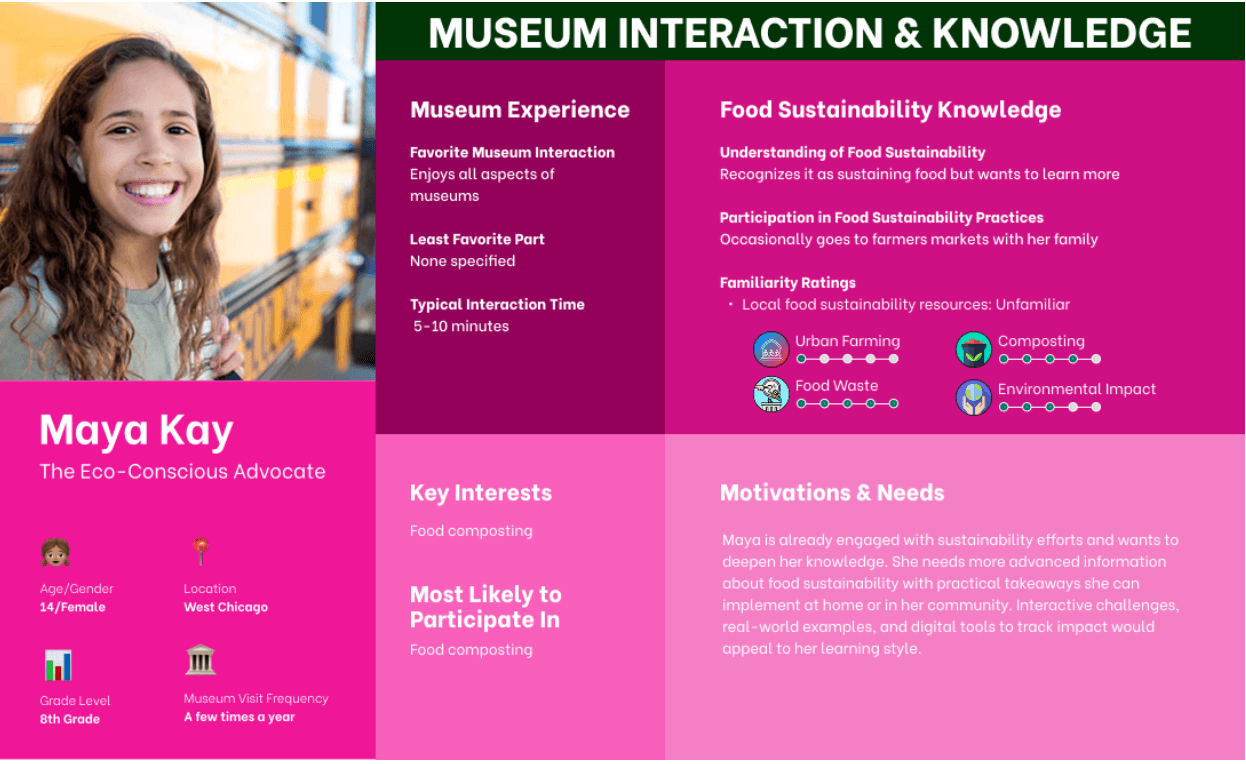
Our team conducted a Google Forms survey targeting students ages 12–15, gathering both quantitative and qualitative data across museum experience, food sustainability awareness, and interest in learning more.
Key findings:
Students spent an average of 2–5 minutes per exhibit and visited museums just once or twice a year
Awareness of urban farming and composting was low (most scored 1–3 out of 5)
Students were most interested in learning about urban farming, composting, and the environmental impact of food choices
Interactive and hands-on exhibits were consistently cited as the most enjoyable museum experiences
These findings directly shaped our design decisions — particularly the choice to lead with a gamified experience over static informational displays.
My Role — UI Design and Research
As the Visual/UI Design Lead, I was responsible for translating our research insights and team concepts into cohesive, polished screen designs. My contributions included:
Establishing the visual direction for the mid-fidelity prototype, including layout hierarchy, color palette, and typography choices
Designing screen states for the Home Screen, Game flow, Video player, and Food Pledge screens
Ensuring visual consistency across all screens while maintaining accessibility standards
Applying an inclusivity lens to iconography and content presentation to reflect diverse cultural food backgrounds
Design Process
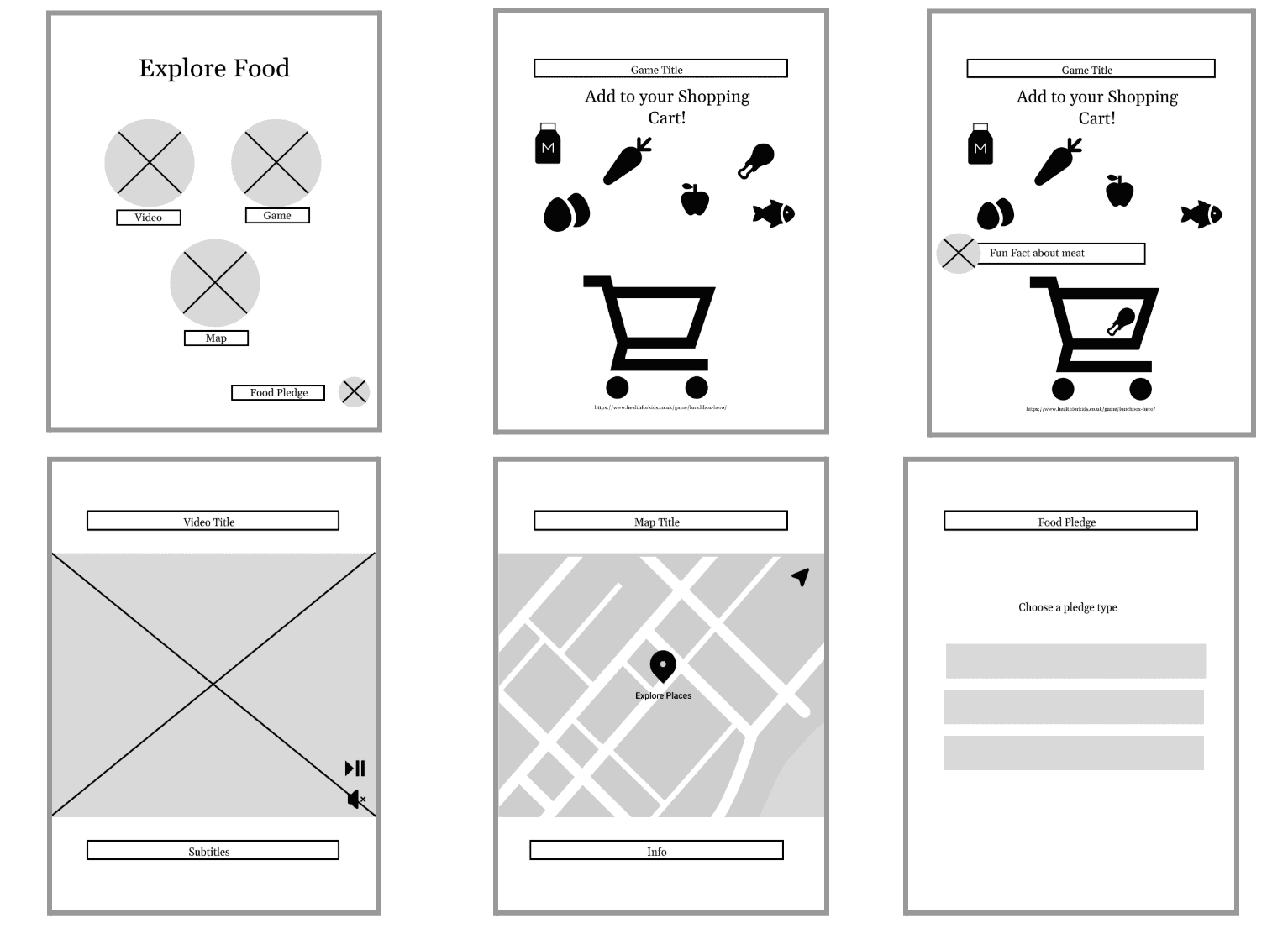
Low-Fidelity Wireframes We began with hand-sketched wireframes to map out the core user flow — from the idle screen tap-to-start moment, through the home screen hub, and into each of the four activities: Video, Game, Map, and Food Pledge.
Mid-Fidelity Prototype I developed structured layouts with clearer visual hierarchy, introducing the nature-inspired color palette, food imagery, and content organization. This stage allowed us to test legibility, tap target sizing, and overall flow before committing to a final design.
Site Map & User Flow The information architecture was designed to be shallow and fast — prioritizing quick access to any activity from the home screen, given that visitors rarely linger for more than a few minutes.

Key Features
Virtual Grocery Store Game The centerpiece of the experience. Users explore a virtual store, select ingredients, and learn sustainability facts — how much water each ingredient requires, composting tips, and environmental impact. After exploring, users select a personalized food pledge. Based on client feedback from our museum contact Miranda, we shifted from meal-based choices to individual ingredients to better reflect cultural diversity in food backgrounds.
Interactive Chicago Map An explorable map pinpointing local farmers markets, food pantries, community gardens, and sustainability organizations — giving users a direct connection between the exhibit and their own neighborhoods.
Video Player An updated video experience with user controls, subtitles, and volume adjustment — increasing accessibility and giving visitors more autonomy over how they engage with the content.
Food Pledge At the end of the game, users choose a personalized sustainability pledge that is displayed on the main screen. C3 resources are surfaced here, creating a natural bridge from inspiration to real-world action.
Outcome & Reflection
Our design successfully addressed the museum's need for a more engaging, accessible, and action-oriented exhibit. The final concept was presented to our clients Jennifer and Miranda at the Peggy Notebaert Nature Museum.
This project taught me how to design within real constraints — a limited interaction window, a specific reading level, a dual audience of kids and adults, and a client mission that extended beyond the screen. It also deepened my thinking around inclusive design, particularly how small decisions like swapping "meals" for "ingredients" can make an experience feel welcoming to a much wider audience.